
An objective biological layer in an evaluation that often relies on
subjective observation alone.
The MDM™ Urinary Metabolite Panel is a laboratory-based screening aid for children ages 2 and older, measuring metabolic and microbial markers associated with autism spectrum conditions.
Designed to complement developmental surveillance, standardized screening, and clinical evaluation — not to replace them. Intended as adjunctive decision support for physicians already working within AAP/CDC-aligned pathways.

What this test is — and explicitly is not.
We lead with scope because bounded claims are the only ones a clinician can defensibly recommend.
An adjunctive, laboratory-based metabolic screening panel.
Not a diagnosis, not a substitute for clinical evaluation.
Where MDM fits in your practice.
The panel is most defensible as a second-line tool after developmental concern has already been documented — not as a first-line screen in well-child visits.
The family or caregiver has raised concern, an M-CHAT-R or equivalent is abnormal or borderline, and you are weighing how much urgency to bring to the evaluation pipeline.
A multi-month wait for developmental pediatrics or neurology. MDM offers an interim objective data point that may help calibrate the family's expectations and your clinical urgency.
Clinical picture does not clearly meet DSM-5-TR criteria and subjective variables dominate. An additional objective layer may inform shared decision-making with the family.
Children with overlapping GI complaints — chronic constipation, bloating, selective eating — and concurrent developmental or sensory concerns where metabolic markers may add context.
How MDM sits inside existing pathways.
Designed to be additive, not disruptive — the test is ordered after a concern has been surfaced through standard developmental surveillance.

The lab infrastructure behind each result.
Physicians recommend laboratories, not marketing. These are the systems that underwrite every report.

Transparent about the evidence base — including what it doesn't yet include.
We have chosen to publish the study design, cohort characteristics, and publication status rather than lead with performance claims out of context.
Known limitations, stated up front
- Validation to date is based on a contained clinical cohort; pending replication in larger, independent, multi-site populations.
- Intended for use in children where developmental concern is already present; general-population screening performance is not established.
- No single biomarker panel can confirm or exclude autism spectrum conditions; full developmental evaluation remains the clinical standard.
- External, peer-reviewed clinical validation literature is still accumulating; additional publications are in progress.
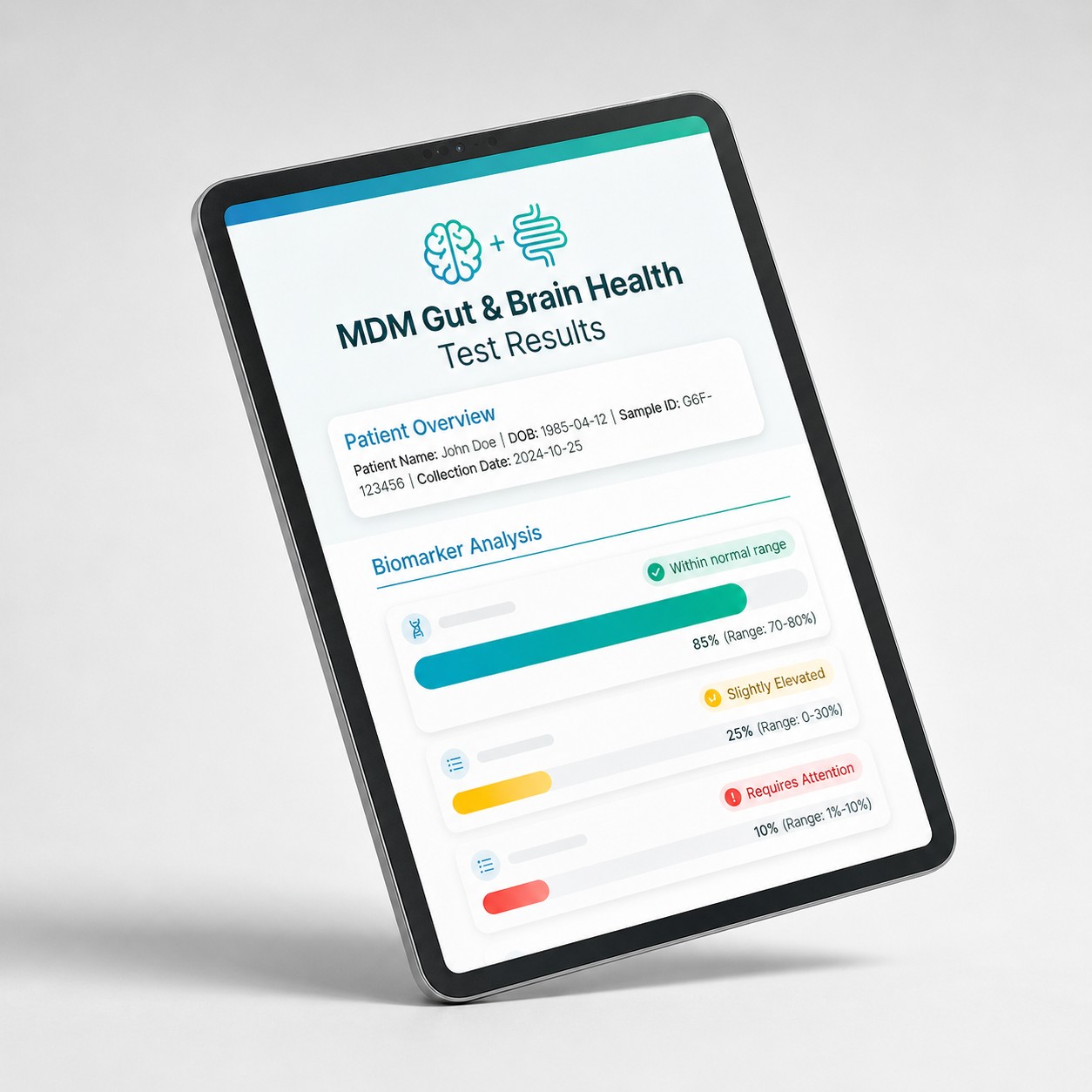
A report you can actually use in a clinical conversation.
Designed for physician review first — clear limits, clear intended use, clear next steps. Parent-readable summary is separated from the clinical data.
Result-by-result guidance — aligned with standard clinical judgment.
These pathways describe how most clinicians choose to act on results. Final management remains entirely at your clinical discretion.
Biomarker pattern outside typical range
Consistent with additional developmental/behavioral context already documented in the chart.
- Escalate or expedite pending referral for formal developmental evaluation.
- Discuss family-facing supports (early intervention referral as appropriate) during the waiting period.
- Document that diagnosis is not being made on the basis of this result alone.
Mixed or borderline pattern
Result does not clearly fall within typical or atypical ranges; interpretation depends heavily on clinical context.
- Proceed with planned developmental evaluation on original timeline — result neither accelerates nor de-escalates.
- Consider repeat surveillance at a defined interval if symptoms evolve.
- Discuss with the family that no single test resolves all uncertainty.
Biomarker pattern within typical range
This does not rule out ASD; clinical judgment and ongoing surveillance remain primary.
- Continue developmental surveillance per AAP guidance; do not cancel referrals based on this result alone.
- Document as one negative adjunct data point — clinical concern, if still present, should still drive evaluation.
- Offer structured re-check at the next developmental checkpoint if caregiver concerns persist.
From requisition to clinical report — four steps.
Straightforward to integrate; low overhead on clinic staff.
Clinicians who find MDM most useful.
We are selective about who we invite into this workflow. The clinicians below tell us MDM adds the most to their practice — and we are equally clear about when it is not the right tool.
The questions clinicians actually ask us.
Short, honest answers. If you need deeper materials for EBM review, request the clinical brief.
Review the evidence package, a sample report, and the intended-use framework — before you decide whether this belongs in your practice.
We'll send a concise, clinician-only packet. No marketing, no family-facing copy — just the materials you would need to form your own judgment.
What you'll receive
- Clinician brief: intended use, methodology, known limitations, and publication status.
- A fully-anonymized sample report in the exact format a physician receives.
- Preprint link, ongoing validation summary, and proactive disclosure of what is and isn't yet peer-reviewed.
- Optional peer-to-peer consult with our reviewing medical director.